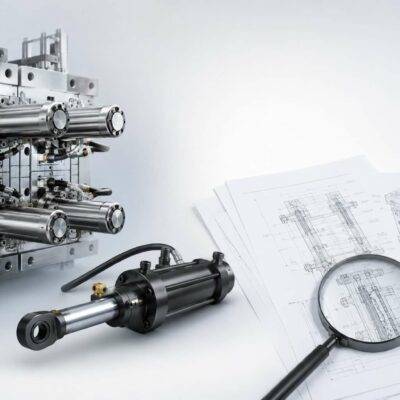

Why the First Diagnosis Is Frequently Wrong
Oil leakage is one of the most common problems encountered in hydraulic cylinders used in injection molds and die casting dies.
When leakage appears, the first reaction is almost always the same.
The seals are blamed.
Maintenance personnel often assume that worn sealing elements are responsible and immediately order replacement seal kits, softer seals or even complete replacement cartridges.
Although this approach may occasionally solve the problem, it is also responsible for many unnecessary repairs.
In reality, an oil leak is a symptom, not a diagnosis.
The real cause may lie elsewhere.
A valuable engineering case handled by the Vega Technical Department demonstrates how a systematic root cause analysis can prevent unnecessary modifications and identify the actual source of hydraulic leakage.
The Customer’s Complaint
A customer operating a stack mold manufactured in Portugal reported an alarming problem.
The mold contained 24 Vega hydraulic cylinders, including 22 CM025CGHGX50 cylinders and 2 CM025 cylinders with O-ring configuration.
After approximately 70,000 production cycles, the customer estimated an oil loss of nearly 200 litres.
Surprisingly, however, the maintenance team could not determine where the oil was actually leaking from.
This detail immediately changes the engineering approach.
If the leak source cannot be identified, replacing components becomes little more than educated guesswork.
The First Assumption
Because the cylinders were operating at only 40 bar, the customer believed that softer sealing elements might provide a better solution.
The immediate request was therefore straightforward.
A quotation was requested for 22 replacement sealing cartridges.
This response is understandable.
When oil disappears from a hydraulic system, seals naturally become the primary suspects.
However, experienced engineers know that hydraulic systems contain many possible leakage paths.
Without identifying the exact location of the leak, replacing seals may simply increase repair costs without solving the underlying problem.
Vega Questioned the Original Diagnosis
Instead of immediately accepting the customer’s conclusion, Stefano Rogora approached the situation differently.
Rather than discussing replacement seals first, he asked an apparently unrelated question.
Why was the customer considering changing the cylinder design?
Only two weeks earlier, another discussion had indicated that the customer’s difficulties were associated with the mechanical switch guidance system, particularly the guidance of the control shaft, rather than with hydraulic sealing.
This simple observation represents one of the most important principles of engineering troubleshooting.
Before changing any component, engineers should verify that they are solving the correct problem.
A Completely Different Solution
Instead of recommending a different hydraulic cylinder, Vega proposed improving the existing design.
Stefano suggested supplying a special control shaft with additional length, increasing the guidance of the mechanical switching system.
With this modification, approximately 50 mm of the control shaft would protrude from the rear of the cylinder when fully retracted, providing improved guidance during operation.
This recommendation is particularly interesting because it demonstrates that solving one problem does not always require replacing the entire component.
Sometimes a relatively small design modification can eliminate the real cause of the customer’s difficulties.
Could the Mold Be Responsible?
The customer also questioned whether the manifold machining might be responsible for the oil leakage.
Photographs of the manifold were supplied together with the enquiry.
Rather than confirming this hypothesis, the Vega Technical Department took a balanced engineering position.
Stefano explained that he did not believe the manifold machining was the primary cause of the leakage.
However, after approximately 70,000 operating cycles, he recommended inspecting the condition of the existing O-rings.
If necessary, the cylinders already installed in the mold could be modified by increasing both the O-ring diameter and the dimensions of the O-ring groove.
Notice the sequence of decisions.
First verify.
Then inspect.
Only afterwards consider modification.
This is exactly how systematic root cause analysis should be performed.
Oil Leaks Have Many Possible Origins
One of the most valuable lessons from this case is that hydraulic oil leakage rarely has a single possible cause.
Depending on the application, oil may escape from:
- dynamic rod seals;
- piston seals;
- static O-rings;
- threaded hydraulic ports;
- fittings and adapters;
- manifold interfaces;
- damaged sealing grooves;
- machining tolerances;
- incorrect assembly procedures.
Without identifying the precise leakage path, replacing seals becomes a process of trial and error rather than engineering.
For this reason, experienced maintenance engineers spend more time locating the leak than replacing components.
Root Cause Analysis Begins With Questions
Perhaps the most interesting aspect of this case is not the technical modification itself.
It is the methodology.
Rather than immediately providing replacement parts, the Vega Technical Department first asked questions.
- Where is the oil actually leaking?
- Has the leakage source been confirmed?
- Is the problem hydraulic or mechanical?
- Has anything changed since the previous technical discussion?
- Could another component be responsible?
Only after answering these questions does it become possible to select the appropriate corrective action.
This approach reflects the philosophy used throughout professional engineering.
Successful troubleshooting is based on evidence, not assumptions.
Looking Beyond the Seals
Many hydraulic cylinders are dismantled every year simply because an oil leak is observed.
In some cases, replacing the seals is absolutely the correct solution.
In others, the seals were never the problem.
This engineering case reminds us that maintenance should always focus on identifying the real failure mechanism rather than replacing the component that appears most likely to be responsible.
The difference between these two approaches often determines whether a repair permanently solves the problem or merely postpones it.