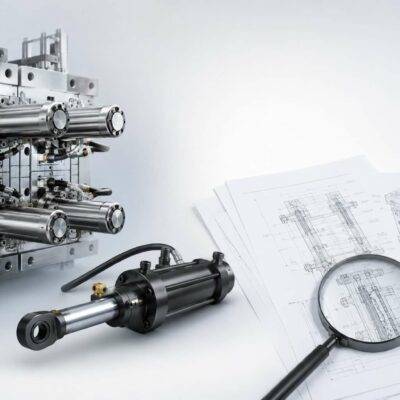

Hydraulic cylinder air testing is a common practice during mold assembly and maintenance. However, testing a hydraulic cylinder with compressed air may produce results that differ significantly from those obtained during normal hydraulic operation.
When a hydraulic cylinder does not move smoothly during testing, the immediate conclusion is often simple:
“There must be something wrong with the cylinder.”
The seals are inspected.
The guide rings are measured.
The tolerances are checked.
Sometimes the cylinder is even disassembled and modified.
However, in engineering, the first diagnosis is not always the correct one.
Recently, Vega Technical Dep. was asked to investigate a problem involving several compact hydraulic cylinders used in an injection mold application. The customer reported that some cylinders moved freely while others exhibited noticeably higher friction during testing. In several cases, the guide rings had even been manually polished to improve movement.
At first glance, the explanation appeared straightforward.
The guide rings seemed to create excessive friction.
But after analyzing the operating conditions, Vega Technical Dep. identified a completely different root cause:
the cylinders were being tested under conditions very different from those for which they had been designed.
The Initial Complaint
The customer reported that several compact hydraulic cylinders showed different sliding characteristics.
Some cylinders moved smoothly.
Others required significantly higher force to initiate movement.
The problem was considered particularly critical because multiple cylinders had to operate simultaneously within the same injection mold. Differences in friction could therefore compromise synchronization and affect the overall mold performance.
To reduce friction, some guide rings had even been manually polished before installation.
The assumption was that the problem originated from excessive interference between the guide rings and the cartridge housing.
The First Engineering Question
Rather than immediately investigating manufacturing tolerances, Vega Technical Dep. asked a simple question:
“Under which conditions are the cylinders being tested?”
The answer changed the entire investigation.
The cylinders were being tested using compressed air at approximately:
8 bar
instead of hydraulic oil.
This detail proved to be fundamental.
Why Hydraulic Cylinder Air Testing Can Produce Misleading Results
Although both devices produce linear motion, hydraulic cylinders and pneumatic cylinders operate according to very different physical principles.
Hydraulic cylinders are designed to operate with:
- hydraulic oil;
- lubricated seals;
- hydrodynamic lubrication films;
- relatively high operating pressures;
- low fluid compressibility.
Pneumatic systems, on the other hand, operate with:
- highly compressible air;
- minimal lubrication;
- lower operating forces;
- different friction characteristics.
Testing a hydraulic cylinder with compressed air is therefore not equivalent to testing it under hydraulic operating conditions.
The Importance of Hydraulic Lubrication
One of the most important characteristics of hydraulic oil is that it does not simply transmit pressure.
It also provides lubrication.
During normal operation, a thin oil film develops between:
- seals;
- guide rings;
- sliding surfaces;
- moving components.
This lubrication film significantly reduces friction and ensures smooth cylinder operation.
Compressed air cannot provide this effect.
As a consequence, the friction measured during pneumatic testing may be substantially higher than the friction occurring during actual hydraulic operation.
Static Friction Versus Dynamic Friction
Another important factor is the difference between static and dynamic friction.
Static friction represents the force required to initiate movement.
Dynamic friction represents the force required to maintain movement.
The relationship can be expressed as:
Fstatic > Fdynamic
In hydraulic systems, the lubricating oil film reduces both values.
During pneumatic testing, however, the absence of lubrication causes the static friction component to become much more significant.
As a result, cylinders may appear to operate irregularly even though they are functioning correctly under their intended operating conditions.
Why Guide Ring Interference Is Necessary
The customer suspected that the blue guide rings generated excessive friction.
However, guide ring interference is not a manufacturing defect.
It is a design requirement.
Guide rings perform several critical functions:
- maintaining rod alignment;
- absorbing radial loads;
- preventing metal-to-metal contact;
- ensuring dimensional stability;
- extending seal life.
Reducing the guide ring interference excessively could indeed reduce friction during testing.
Unfortunately, it could also lead to:
- increased wear;
- poor guidance;
- reduced positioning accuracy;
- shorter cylinder life.
In other words:
solving the apparent problem could create a real problem.
The Influence of Oil Compressibility
Another important difference between pneumatic and hydraulic testing is fluid compressibility.
According to hydraulic theory, oil is not perfectly incompressible.
However, its compressibility is extremely low compared with compressed air.
The volumetric reduction of hydraulic oil can be approximated as:
ΔV ≈ 1% every 160 bar
under normal industrial conditions.
Compressed air, by contrast, behaves like a spring.
This causes:
- delayed movements;
- non-uniform accelerations;
- inconsistent positioning;
- misleading evaluations of cylinder performance.
Therefore, testing a hydraulic cylinder with compressed air may produce behavior that would never occur during actual operation.
Why Pressure Matters
The customer was testing the cylinders at approximately:
8 bar
However, the cylinders had been designed to operate at hydraulic pressures significantly higher than this value.
At low pressures:
- seal preload becomes more significant;
- guide ring friction becomes more evident;
- lubrication effects are reduced;
- movement may appear irregular.
Once normal hydraulic operating pressure is reached, the behavior of the system changes substantially.
Engineering Means Understanding Physics
This project demonstrated an important engineering principle.
The customer initially believed that the cylinders suffered from excessive internal friction.
The investigation showed that:
- the cylinders were correctly manufactured;
- the tolerances were correct;
- the guide rings were functioning as designed;
- the observed behavior resulted primarily from the testing methodology.
The problem was not the hydraulic cylinder.
The problem was evaluating a hydraulic component under non-hydraulic conditions.
Lessons Learned
1. Hydraulic cylinders should be tested under hydraulic conditions.
2. Compressed air and hydraulic oil produce very different physical behavior.
3. Lubrication is an essential part of hydraulic cylinder performance.
4. Guide ring interference is a design feature, not necessarily a defect.
5. Static friction measurements at low pressure can be misleading.
6. Engineering investigations should always start by verifying the test conditions.
Conclusion
At first glance, this case appeared to be a problem of excessive friction inside several compact hydraulic cylinders.
A deeper investigation revealed that the cylinders themselves were functioning correctly.
The apparent malfunction originated from the testing method rather than from the hydraulic components.
By identifying the difference between pneumatic testing and hydraulic operation, Vega Technical Dep. prevented unnecessary modifications and helped the customer understand the physical principles governing the system.
Because in engineering, before asking:
“What is wrong with the component?”
we should first ask:
“Are we testing the component under the correct conditions?”