
Introduction
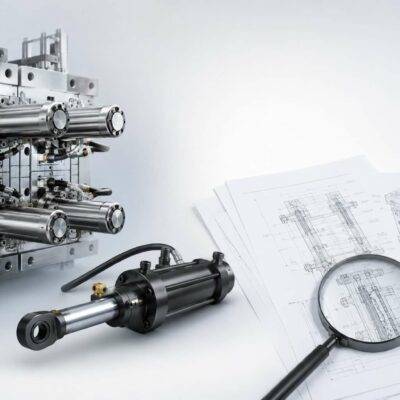
The transition from hydraulic to electric actuation has become one of the most significant technological trends in injection mold engineering.
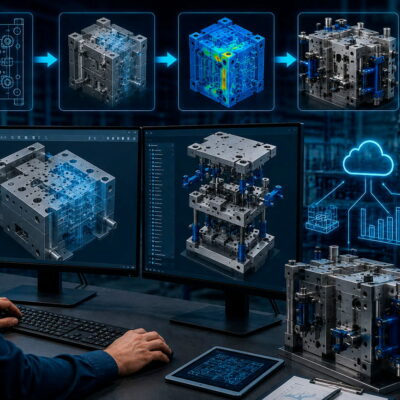
Driven by increasing demands for energy efficiency, sustainability, process repeatability, predictive maintenance, and digital manufacturing, more mold makers are evaluating whether traditional hydraulic cylinders can be replaced with electric actuators.
At first glance, the conversion appears straightforward.
Replace the hydraulic cylinder with an electric actuator having the same stroke and force.
Unfortunately, reality is far more complex.
A real engineering project analyzed by the Vega Technical Department demonstrates that converting a hydraulic mold into a fully electric system involves much more than selecting a different actuator. Machine dimensions, available installation space, motor torque, structural loads, duty cycle, servo control strategy, and mold kinematics must all be evaluated before determining whether the conversion is technically feasible.
This case study perfectly illustrates an important engineering principle:
Replacing a hydraulic cylinder with an electric actuator is not a component substitution. It is a complete system redesign.
Why the Industry Is Moving Toward Electric Actuation
For decades, hydraulic cylinders have been the preferred solution for moving slides, cores, and unscrewing mechanisms inside injection molds.
Hydraulic systems offer:
- extremely high force density;
- compact overall dimensions;
- proven reliability;
- simple control;
- excellent overload capability.
However, modern manufacturing introduces new requirements.
Today, mold makers increasingly demand:
- lower energy consumption;
- cleaner production environments;
- elimination of hydraulic oil;
- programmable positioning;
- real-time monitoring;
- Industry 4.0 connectivity;
- predictive maintenance.
Electric actuators satisfy many of these requirements while offering exceptional positioning accuracy and full digital control.
Yet replacing hydraulics is rarely as simple as it appears.
The Engineering Challenge
A customer approached the Vega Technical Department requesting a complete full-electric conversion of two injection molds previously operated using hydraulic cylinders.
The objective was ambitious:
replace the existing hydraulic core pull system with electric actuators supplied as a complete turnkey solution.
Before proposing any actuator, Vega first had to answer a fundamental engineering question:
Is the conversion mechanically feasible?
The First Unexpected Problem: Space
During the on-site inspection, Stefano Rogora physically measured the available installation space inside the mold.
The existing hydraulic cylinder occupied approximately:
230 mm
The proposed electric actuator required:
444 mm
Almost twice the installation length.
This immediately demonstrated that actuator selection was not the primary challenge.
The first challenge was packaging.
The Vega Technical Department identified two possible solutions:
- modify the machine safety door;
- install the mold on a larger injection molding machine.
This illustrates an important engineering lesson.
When converting from hydraulic to electric motion, available space often becomes the first limiting factor—not actuator force.
Mechanical Dimensions Matter More Than Force
Many engineers instinctively compare only:
- stroke;
- maximum force;
- operating speed.
In reality, an electric actuator introduces many additional dimensional constraints:
- motor length;
- gearbox dimensions;
- encoder housing;
- cable routing;
- maintenance clearance;
- cooling requirements.
Even when force and stroke match perfectly, the actuator may simply not fit inside the mold.
Mechanical integration therefore becomes the first design verification.
The Second Engineering Challenge: Holding Torque
During the engineering meeting, the customer introduced an additional requirement that had not been previously specified.
The electric motors had to maintain holding torque throughout the injection phase, even though the slide was already mechanically locked.
This requirement dramatically changed the engineering analysis.
Maintaining torque continuously differs fundamentally from generating motion.
The selected servo motor had to be evaluated for:
- continuous torque;
- thermal stability;
- duty cycle;
- current consumption;
- motor heating;
- long-term reliability.
An actuator capable of moving the slide is not necessarily capable of holding torque indefinitely.
Why Real Engineering Starts with Real Data
Rather than immediately proposing a solution, the Vega Technical Department requested additional technical information.
Specifically:
- complete 3D mold model;
- hydraulic pressure currently used;
- push force;
- pull force.
Why?
Because engineering decisions should always compare:
theoretical calculations
with
real operating conditions.
This represents one of the fundamental principles of engineering.
Real systems rarely behave exactly as predicted by theoretical calculations.
Comparing Hydraulic and Electric Actuation
| Hydraulic Cylinders | Electric Actuators |
|---|---|
| Very high force density | Excellent positioning accuracy |
| Compact dimensions | Larger overall size |
| Excellent overload resistance | Advanced motion control |
| Simple hydraulic circuits | Complex electronic control |
| Continuous force generation | Continuous torque must be verified |
| Oil maintenance required | Minimal mechanical maintenance |
| Difficult condition monitoring | Complete digital diagnostics |
Neither technology is universally superior.
The correct choice depends entirely on the application.
Mold Kinematics Remain the Same
One important misconception is that replacing hydraulics with electric actuators changes mold mechanics.
It does not.
The mold kinematics remain identical.
The same forces still exist.
The same guide friction remains.
The same side loads continue to act.
Only the actuator technology changes.
Consequently, all previous force calculations remain essential.
Only after understanding the complete mechanical system can engineers evaluate whether electric actuation is appropriate.
The Supply Chain Challenge
The email correspondence also highlights another engineering reality.
At the time of the project, Vega’s long-term technology partner for electric actuators had left this market segment.
Simultaneously:
- component costs had increased dramatically;
- delivery times exceeded six months;
- alternative suppliers had to be evaluated;
- the complete solution required redesign.
This illustrates that engineering decisions are influenced not only by technical feasibility but also by industrial realities such as supplier availability, lead times, and project economics.
Engineering Is More Than Component Selection
One aspect of this case perfectly represents the engineering philosophy of the Vega Technical Department.
Instead of asking:
“Which electric actuator should we install?”
the engineers first asked:
- Will it fit?
- Can it hold torque?
- Is the mold mechanically compatible?
- What forces actually occur?
- What hydraulic pressures are currently used?
- Can theoretical calculations be validated with real operating data?
Only after answering these questions can actuator selection begin.
Lessons Learned
1. Hydraulic-to-electric conversion is a complete engineering project, not a simple component replacement.
2. Installation space often becomes the first design limitation.
3. Continuous holding torque must always be verified.
4. Existing hydraulic operating data are invaluable for electric actuator sizing.
5. Mold kinematics do not change when actuator technology changes.
6. Real engineering compares theoretical calculations with measured operating conditions.
7. The best actuator is the one that integrates successfully into the complete mechanical system.
Conclusion
This project demonstrates that converting an injection mold from hydraulic to electric actuation requires far more than selecting a servo actuator with equivalent force.
Successful conversion demands a complete understanding of:
- mechanical integration;
- available installation space;
- structural loads;
- continuous torque requirements;
- hydraulic operating conditions;
- mold kinematics;
- long-term system reliability.
The Vega Technical Department approached the project not as a supplier of electric actuators but as an engineering partner, carefully validating every aspect of the system before proposing a solution.
That methodology ultimately represents the difference between replacing a component and designing a reliable production system.
Electric actuators do not replace hydraulic cylinders. Well-engineered electric systems replace well-understood hydraulic systems.