Why runner design is so important
The runner system controls how molten plastic enters the mold.
A correct design improves:
- filling performance
- cosmetic quality
- dimensional stability
- cycle time
A poor design may create:
- pressure loss
- short shots
- warpage
- cavity imbalance
How plastic flows inside the mold
When molten plastic flows through runners and gates, it encounters:
- friction
- geometrical variations
- temperature changes
These factors directly affect:
- viscosity
- flow speed
- pressure
For this reason, runner systems must be carefully engineered.
Balanced runners in multi-cavity molds
In multi-cavity molds, flow balance is critical.
If one cavity fills faster than the others, problems may appear:
- dimensional variations
- cosmetic differences
- unstable production
Balanced runner systems distribute plastic evenly.
This improves:
- quality
- repeatability
- productivity
Cold runner vs hot runner systems
Cold runner systems are simpler and less expensive.
However, they:
- generate material waste
- increase cycle time
- require more energy
Hot runner systems reduce waste and improve flow control.
But they require:
- precise thermal management
- advanced engineering
- higher technical integration
Why runner geometry matters
Runner geometry completely changes flow behavior.
Circular or optimized cross-sections improve:
- efficiency
- pressure control
- filling uniformity
Sharp corners and sudden diameter changes increase:
- turbulence
- shear stress
- energy loss
Integration with modern engineering workflows
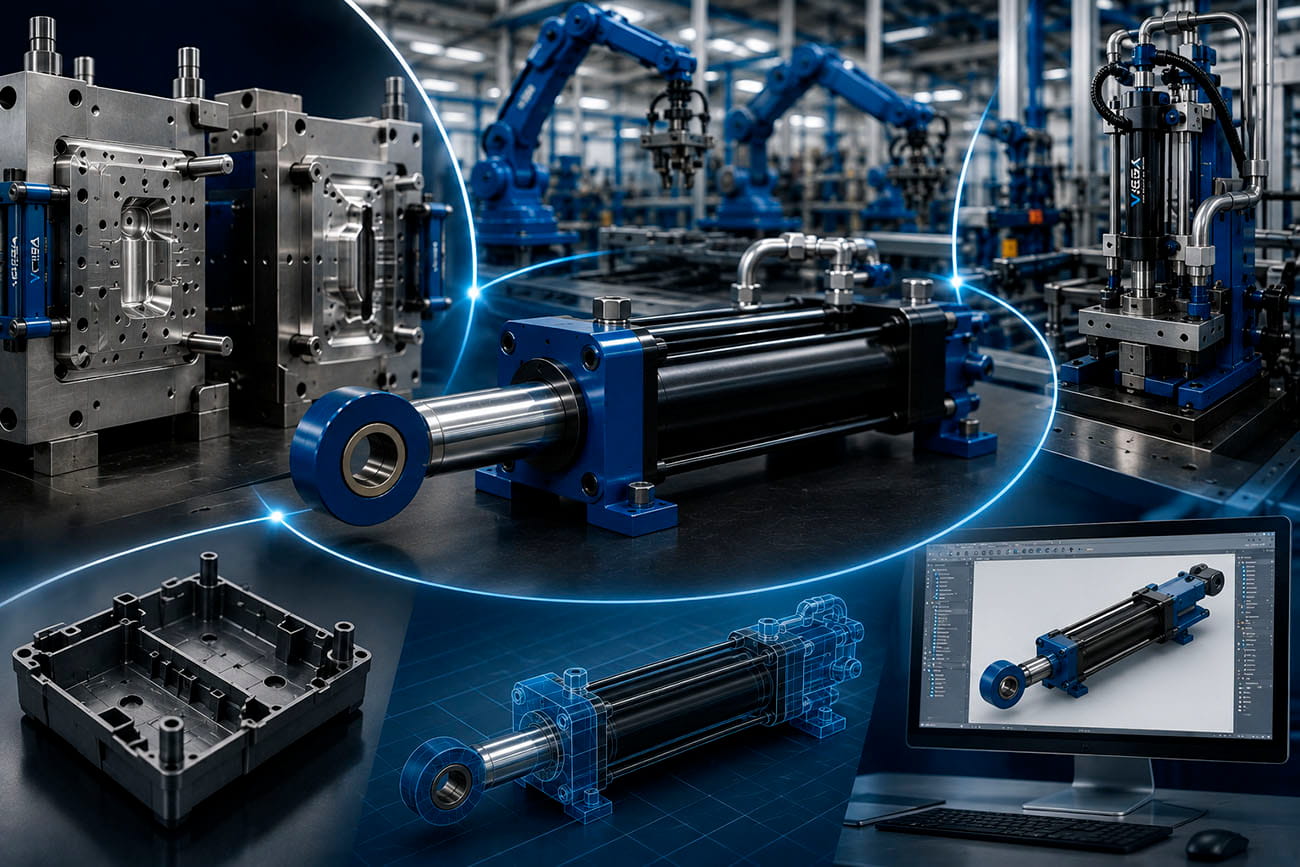
Today mold designers work with increasingly integrated systems.
Parametric configurators and 3D CAD platforms are becoming essential engineering tools.
Platforms such as Vega Cylinders allow engineers to:
- configure hydraulic cylinders online
- download CAD models
- verify compatibility
- accelerate engineering workflow
This reduces design errors and improves mold development speed.
The future of mold engineering
In the future of injection molding:
- simulation
- automation
- parametric CAD
- real-time manufacturing
will become increasingly interconnected.
Companies capable of integrating engineering and manufacturing in real time will gain major advantages in speed, quality and competitiveness.