
When engineers size a hydraulic cylinder, the first question is usually straightforward:
How much weight must the cylinder move?
It seems like a logical starting point.
After all, if you know the mass of the moving components, calculating the required force should be relatively simple.
But in injection mold engineering, the most important force is often not the weight of the moving parts.
It is the force nobody calculates.
Recently, Vega Technical Dep. was asked to review the sizing of hydraulic cylinders for a mold equipped with a large ejector system.
The customer had already performed the calculations and believed the required force was relatively low.
At first glance, the numbers appeared reasonable.
But after reviewing the 3D model, Vega reached a very different conclusion.
The Initial Calculation
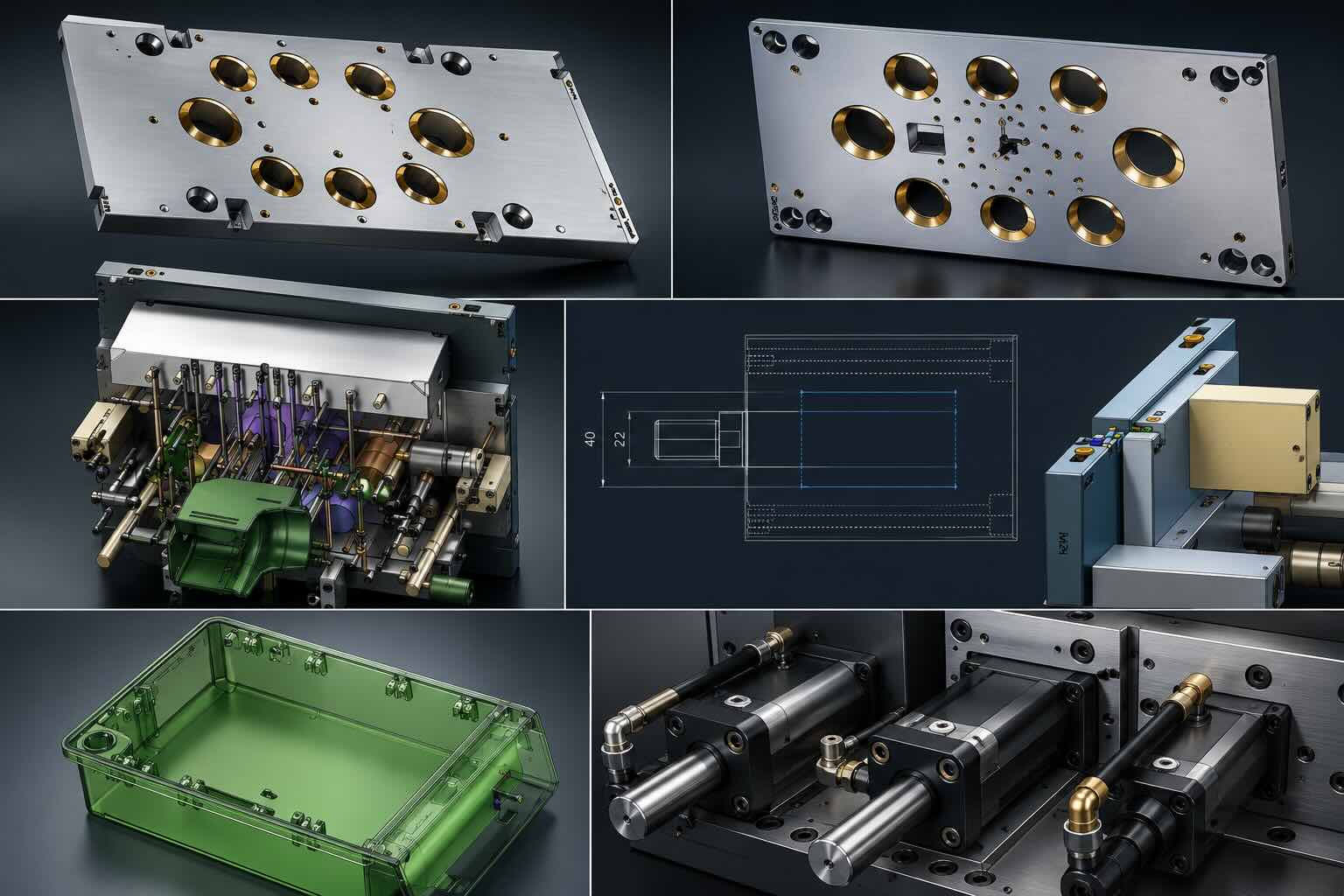
The customer had carefully evaluated the weight of the moving plates.
The analysis showed:
- Plate A weight: approximately 80 kg
- Plate B weight: approximately 49 kg
- Total moving mass: approximately 129 kg
Since the movement was driven by two hydraulic cylinders, the calculated traction force was approximately:
64.5 kgf per cylinder
Based on this evaluation, the customer believed that a relatively small cylinder would be sufficient.
From a purely mechanical perspective, the reasoning appeared correct.
But there was a problem.
The calculation considered only the weight of the moving assembly.
It did not consider the molded part.
Looking Beyond the Moving Mass
When an injection mold opens, the ejector system does not simply move steel plates.
It must also separate the molded component from the mold.
Depending on the geometry of the part, this can require forces many times greater than the weight of the ejector assembly itself.
For this reason, Vega Technical Dep. requested the 3D model and reviewed the actual geometry of the molded component.
The analysis revealed something important.
The customer had not considered the large internal lateral surfaces of the plastic part that remained in contact with the ejector pins during extraction.
This completely changed the calculation.
The Hidden Force
When a plastic part cools, it shrinks around the steel surfaces inside the mold.
As a result, the ejector system must overcome not only gravity and mechanical friction but also:
- Material shrinkage
- Surface adhesion
- Friction between plastic and steel
- Extraction resistance generated by the geometry of the part
These forces are often referred to collectively as stripping forces.
And in many applications they become the dominant factor in cylinder sizing.
This was exactly the situation in this project.
Measuring the Real Contact Surface
Using the 3D model, Vega Technical Dep. measured the internal lateral surfaces involved in the extraction process.
The result was striking.
The total contact area exceeded:
13,000 cm²
At this point, the weight of the moving plates became almost irrelevant.
The extraction force generated by the plastic part was clearly the dominant load.
To estimate the real operating conditions, Vega applied an adhesion coefficient appropriate for the material and considered the elevated temperature of the component during the pulling phase.
The resulting extraction force was approximately:
6,570 kgf
From 64.5 kgf to 6,570 kgf
This is where the project became particularly interesting.
The customer’s calculation suggested:
64.5 kgf per cylinder
The engineering analysis performed by Vega identified a force of approximately:
6,570 kgf
More than one hundred times greater.
Nothing was wrong with the customer’s calculation.
It simply focused on the wrong force.
The weight calculation was correct.
It just wasn’t the force that would determine the success or failure of the application.
Why Mold Designers Must Consider Stripping Force
Many cylinder sizing calculations begin with moving masses.
That approach works well in many industrial applications.
Injection molds are different.
In mold engineering, extraction forces are often far greater than the weight of the moving components.
Factors influencing stripping force include:
- Plastic material
- Shrinkage rate
- Part geometry
- Contact surface area
- Mold temperature
- Surface finish
- Draft angles
Ignoring these variables can lead to severe cylinder undersizing.
And an undersized cylinder can create:
- Incomplete ejection
- Part damage
- Production instability
- Excessive wear
- Premature component failure
The Recommended Solution
After completing the analysis, Vega Technical Dep. recommended:
Two CM063 hydraulic cylinders operating at 140 bar.
This recommendation was not based on the weight of the ejector plates.
It was based on the actual extraction force generated by the molded component.
In other words, the cylinders were sized for the real load, not the visible load.
The Difference Between Calculation and Engineering
This project perfectly illustrates the difference between performing a calculation and performing an engineering review.
The initial calculation answered the question:
“How much do the moving plates weigh?”
The engineering analysis answered a different question:
“What force must the cylinders actually overcome?”
Those two questions are not always the same.
And in this case, the difference was more than 6,500 kilograms.
Lessons Learned
1. Weight is not always the dominant load
In mold applications, extraction forces often exceed the weight of the moving assembly by a large margin.
2. Geometry matters
The shape and contact area of the molded component directly influence cylinder sizing.
3. Stripping force cannot be ignored
Material adhesion and shrinkage are often critical factors in mold design.
4. 3D model analysis creates value
The most important loads are not always visible in simplified calculations.
5. Engineering begins where assumptions end
The best solutions come from understanding the complete application, not just one part of it.
Conclusion
At first glance, this project appeared simple.
A moving mass of 129 kilograms seemed to require only a modest pulling force.
But a deeper analysis revealed a completely different reality.
The dominant load was not the weight of the ejector system.
It was the force required to separate a large plastic component from the mold.
By reviewing the 3D model and identifying the true extraction forces, Vega Technical Dep. prevented a potentially serious sizing error and ensured that the hydraulic system would perform reliably in production.
Because in mold engineering, the most important force is often the one nobody calculated.