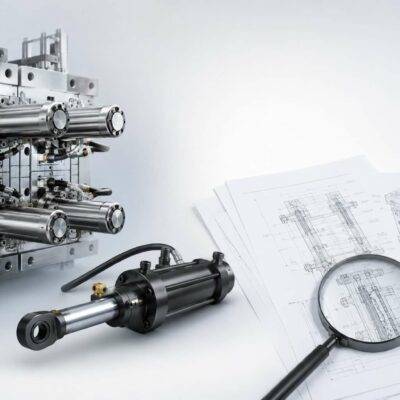

Why Hydraulic Cylinders Should Never Be Used as Structural Guides
Hydraulic cylinders are designed to generate linear force.
They are not designed to function as structural guides capable of absorbing continuous radial loads or compensating for mechanical misalignment.
Nevertheless, in many injection molds, the hydraulic cylinder unintentionally becomes part of the guiding system.
When this happens, the cylinder rod is forced to withstand loads for which it was never designed, often resulting in premature seal wear, rod damage and repeated maintenance problems.
A real engineering case handled by the Vega Technical Department demonstrates how a seal failure was ultimately traced back to the mechanical design of the mold rather than to the hydraulic cylinder itself.
The Customer’s Problem
A customer reported recurring problems with sixteen V400CL hydraulic cylinders installed in an injection mold.
The proposed solution was to purchase new cylinders equipped with piston rods extended by 50 mm.
However, before preparing the quotation, the Vega Technical Department carefully analysed the complete 3D model of the mold.
Instead of immediately approving the new cylinders, the engineering team focused on understanding why the existing cylinders had failed.
This approach reflects an important engineering principle:
understanding the root cause is always more valuable than replacing components.
The Hydraulic Cylinder Was Not the Real Problem
After reviewing the customer’s 3D model, the Vega Technical Department reached an important conclusion.
The problem did not originate from the hydraulic cylinder itself.
It originated from the mechanical arrangement surrounding the cylinder.
According to the engineering analysis, each hydraulic cylinder, piston rod and cartridge was installed inside a special housing manufactured by the customer.
Such a configuration could operate correctly only if every component was assembled with extremely small tolerances and perfect concentricity—conditions that are often very difficult, and sometimes impossible, to achieve in practice.
This observation completely changed the direction of the investigation.
Concentricity Is Essential for Hydraulic Cylinder Reliability
Many designers concentrate on hydraulic pressure, cylinder force and stroke length.
However, concentricity between the hydraulic cylinder, piston rod, cartridge and moving mold plate is equally important.
Even very small alignment errors may introduce lateral forces into a system that was designed to operate only under axial loading.
The Vega Technical Department emphasised that the proposed assembly could function correctly only if all components were perfectly concentric and assembled with extremely tight tolerances.
In real industrial environments, maintaining this level of precision throughout the entire mold is often extremely challenging.
A Longer Rod Increases the Risk of Radial Loads
The engineering investigation identified another critical factor.
The piston rod had been extended by approximately 50 mm beyond its standard configuration.
This extension included a centering seat and was rigidly connected to the ejector plate using a screw.
The Vega Technical Department explained that this rigid connection could generate radial loads whenever:
- the rod and plate were not perfectly aligned;
- the cylinders did not move synchronously;
- the mold introduced slight eccentricities during operation.
Instead of transmitting purely axial forces, the rod could therefore experience continuous bending loads.
These loads are particularly harmful to the sealing system.
Hydraulic Cylinders Should Generate Force, Not Guide Motion
One of the most valuable lessons from this engineering case is the distinction between force generation and mechanical guidance.
A hydraulic cylinder is designed to push and pull along its longitudinal axis.
It should not be expected to compensate for:
- plate misalignment;
- poor concentricity;
- structural deflection;
- synchronization errors;
- guiding inaccuracies.
When the hydraulic cylinder becomes part of the guiding mechanism, its seals and bearings are forced to absorb loads that should instead be carried by dedicated guide elements.
Over time, this significantly reduces service life.
The Engineering Drawings Confirm the Diagnosis
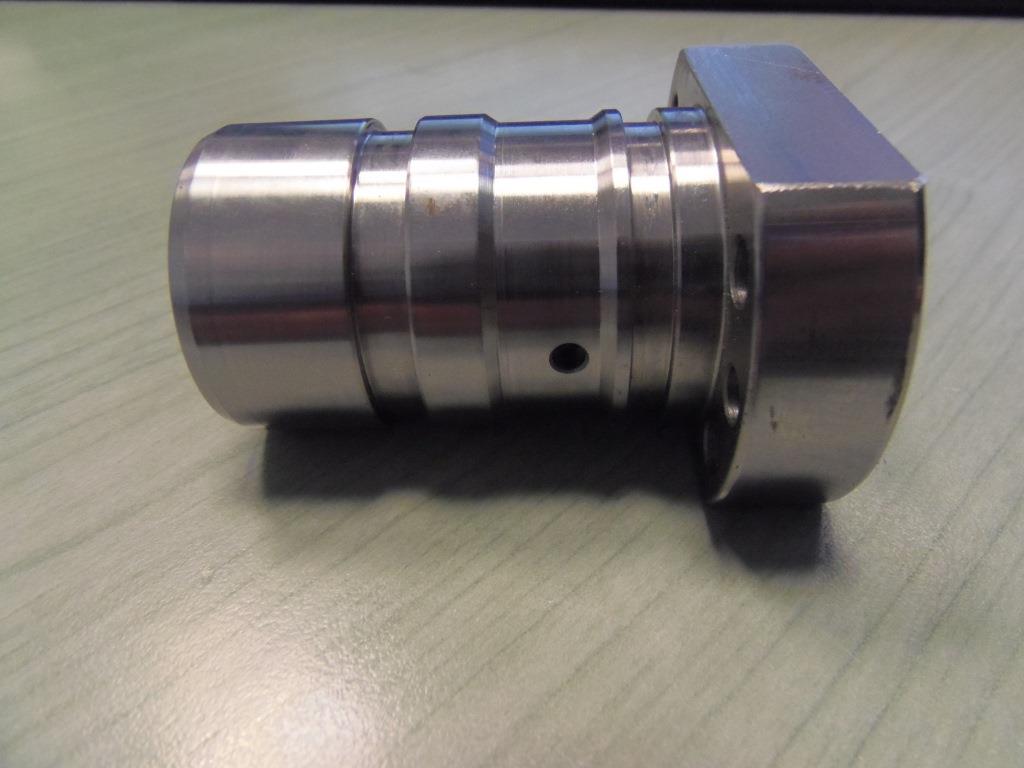
Cartridge CL
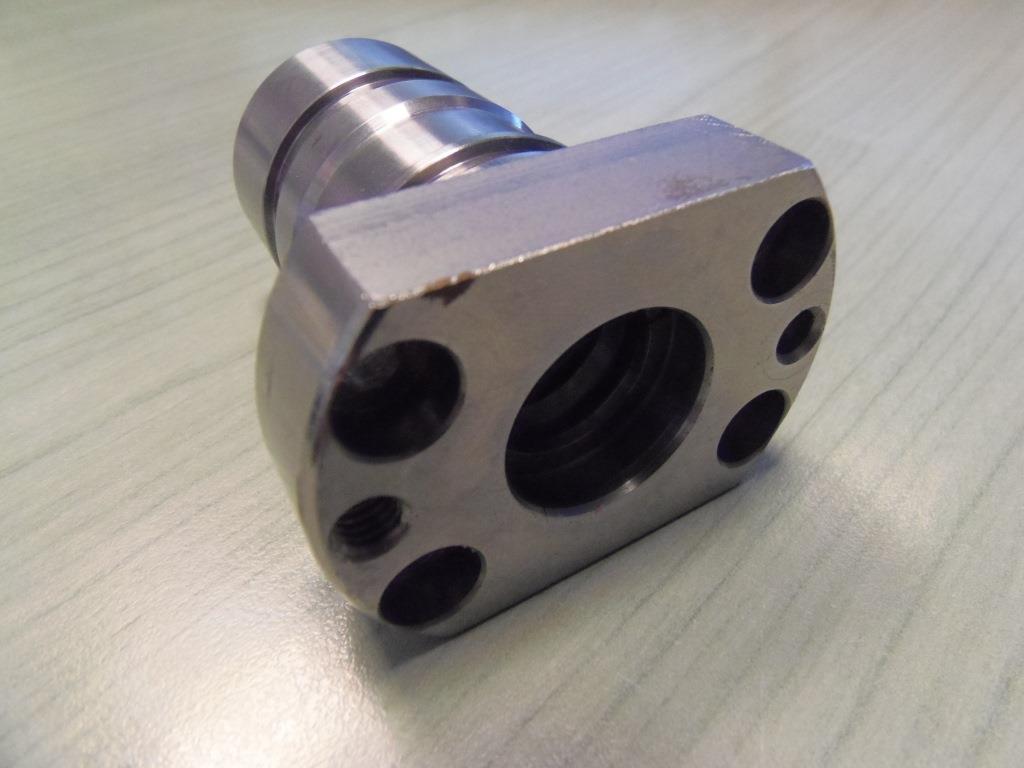
Cartridge CL
The technical drawing prepared during the investigation clearly illustrates the difference between two possible assembly concepts.
One configuration shows a rigid connection between the piston rod and the moving plate.
The alternative proposes the use of a floating joint, allowing the rod to compensate for minor alignment errors while reducing radial forces transmitted to the hydraulic cylinder.
Although the drawing represents only a conceptual solution, it highlights an essential mechanical principle:
allowing controlled movement is often preferable to forcing perfect rigidity.
Engineering Begins by Understanding the Entire Mechanical System
Another remarkable aspect of this case is the engineering methodology adopted by the Vega Technical Department.
Rather than focusing exclusively on the damaged cylinders, the engineers analysed:
- the complete mold assembly;
- the mounting arrangement;
- the rod extension;
- the guiding system;
- the connection between the rod and the ejector plate.
Only after understanding the entire mechanical system could they begin developing possible solutions.
This systematic approach avoids treating symptoms while leaving the real problem unresolved.
Good Engineering Recognises Its Own Limits
One of the strongest messages contained in this correspondence is the honesty of the engineering approach.
Although the Vega Technical Department proposed several improvements, it clearly stated that a complete resolution of the problem could not be guaranteed, because Vega was not the mold designer and the final performance depended on the customer’s mechanical design and assembly quality.
This reflects professional engineering practice.
A hydraulic cylinder manufacturer can optimise the cylinder.
Only the complete machine design can eliminate the root cause.
Eliminating Radial Loads Through Better Mechanical Design
In Part 1, we saw that the premature seal failures were not caused by a defective hydraulic cylinder.
The Vega Technical Department concluded that the real issue was the mechanical design of the mold, where the hydraulic cylinder was forced to absorb radial loads created by misalignment, rigid connections and insufficient concentricity.
Rather than replacing the cylinders immediately, the engineers focused on improving the entire mechanical system.
Why a Floating Joint Reduces Radial Loads
One of the most important recommendations made by the Vega Technical Department was replacing the rigid connection between the piston rod and the ejector plate with a floating joint.
A rigid connection forces the piston rod to follow every movement of the moving plate.
If even a small angular error or eccentricity exists, the rod immediately experiences bending loads.
A floating joint behaves differently.
It allows small angular movements between the piston rod and the moving plate, preventing these alignment errors from being transmitted directly to the hydraulic cylinder.
The engineering sketch clearly illustrates this concept by comparing the traditional rigid connection with a floating joint capable of compensating for minor misalignment while reducing the radial loads acting on the rod.
This simple modification can significantly increase seal life without changing the hydraulic cylinder itself.
Why an Integrated Cylinder Design Can Improve Reliability
The investigation also referred to a similar application previously developed by Vega.
In that project, the solution was not simply to replace the cylinder.
Instead, the Vega Technical Department developed an integrated hydraulic cylinder, where the body and flanged cartridge formed a single assembly.
According to the engineering notes, this configuration reduced the risk of eccentricity, improved sealing performance and was combined with:
- special sealing elements;
- a floating joint between the rod and the moving plate;
- a special piston rod with increased length.
This demonstrates that improving reliability often requires redesigning the complete assembly rather than modifying only one component.
A Longer Rod Is Not Always the Best Solution
The customer requested hydraulic cylinders equipped with piston rods extended by 50 mm.
The Vega Technical Department agreed that this modification could improve the working conditions, but also explained that it could not guarantee a complete solution.
This is an important engineering lesson.
Increasing rod length alone does not eliminate the real cause of radial loading.
If the surrounding mechanical structure remains unchanged, the additional rod length may even increase bending moments under certain operating conditions.
For this reason, rod extension should always be evaluated together with the guiding system and the rod connection.
Perfect Concentricity Is Difficult to Achieve
The engineering analysis repeatedly emphasised that the proposed assembly would operate correctly only if every component were assembled with extremely small tolerances and perfect concentricity.
In real injection molds, however, maintaining perfect alignment throughout thousands or millions of production cycles is extremely challenging.
Manufacturing tolerances, thermal expansion, wear of guide components and repeated mechanical loading all contribute to small positional deviations.
A robust design should therefore tolerate minor misalignment instead of depending on perfect assembly conditions.
The Hydraulic Cylinder Should Never Become the Guide System
One of the most valuable engineering principles illustrated by this case is that hydraulic cylinders should generate force—not guide moving mold components.
Dedicated guide pillars, bushings and guiding systems are designed to absorb lateral loads.
Hydraulic cylinders are designed primarily for axial loading.
When the cylinder is forced to compensate for structural inaccuracies, its seals, bearings and rod become overloaded.
The result is often:
- premature seal wear;
- rod scoring;
- oil leakage;
- increased maintenance;
- shorter cylinder life.
Correct mechanical guidance protects the hydraulic cylinder and improves the reliability of the entire mold.
Engineering Means Analysing the Whole System
Another remarkable aspect of this case is the engineering methodology followed by the Vega Technical Department.
Rather than immediately preparing a quotation for replacement cylinders, the engineers:
- analysed the complete 3D model;
- evaluated the mechanical assembly;
- reviewed the rod extension;
- studied the guiding concept;
- proposed alternative engineering solutions;
- requested physical components for further investigation.
This systematic approach demonstrates that professional engineering focuses on solving problems rather than simply replacing parts.
Good Engineering Does Not Promise Impossible Results
Perhaps the strongest message contained in this correspondence is the honesty of the engineering evaluation.
Even after proposing several improvements, the Vega Technical Department clearly stated that it could not guarantee a 100% solution, because the final result depended on the overall mold design and assembly quality rather than on the hydraulic cylinder alone.
This reflects responsible engineering practice.
Reliable hydraulic systems are created through proper machine design, accurate manufacturing and correct assembly—not by expecting one component to compensate for weaknesses elsewhere in the system.
Conclusion
This real engineering case demonstrates that premature hydraulic cylinder seal failures are often the consequence of mechanical misalignment rather than defects in the hydraulic cylinder itself.
The Vega Technical Department identified insufficient concentricity, rigid rod connections and radial loading as the primary causes of the problem. Instead of recommending a simple replacement, the engineers proposed a floating joint, an integrated cylinder concept, improved sealing and a complete review of the mold assembly while clearly explaining that no component alone could guarantee success if the mechanical design remained unchanged.
This case reinforces one of the most important principles of hydraulic engineering:
Hydraulic cylinders are designed to generate axial force—not to compensate for mechanical misalignment. Long service life is achieved by eliminating radial loads through proper mold design, accurate alignment and appropriate guiding systems.
Related Articles (Verified on icvega.com)
- Hydraulic Cylinder Maintenance
https://www.icvega.com/maintenance/hydraulic-cylinder-maintenance - How to Find the Right Vega Cylinder or Accessory
https://www.icvega.com/choosing/find-right-vega-cylinder-accessory - Choosing the Right Cylinder: Pushing Force
https://www.icvega.com/choosing/choosing-the-right-cylinder-for-your-mold-pushing-force - Choosing the Right Cylinder: Stroke Selection
https://www.icvega.com/choosing/choosing-the-right-cylinder-for-your-mold-stroke