
A Real Technical Support Case on the Importance of Root Cause Investigation
When a hydraulic cylinder suddenly stops working, the natural reaction is to replace it as quickly as possible.
Production must continue, delivery deadlines must be respected, and machine downtime is often far more expensive than the hydraulic component itself.
For this reason, many companies simply replace the failed cylinder and resume production without investigating why the failure occurred.
Although this approach may solve the immediate problem, it often leaves the original cause unresolved.
If the failure was caused by installation errors, overloads, contamination, misalignment, incorrect operating conditions or application design, the replacement cylinder may eventually fail in exactly the same way.
Professional engineering therefore follows a different philosophy.
Replacing the component restores production.
Analyzing the failed component prevents the problem from returning.
This real technical support case demonstrates how the Vega Technical Department balanced immediate customer support with a systematic engineering investigation designed to identify the true root cause of the failure.
The Customer’s Problem
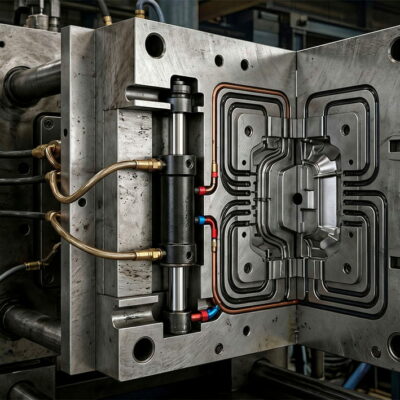
A customer reported that two hydraulic cylinders had been installed in an injection mold during production trials.
Initially, both cylinders operated correctly.
After approximately 50 production cycles, however, one cylinder suddenly stopped functioning while the second cylinder continued operating normally.
The failure occurred during the second mold trial (T2), after the first trial (T1) had been completed successfully.
Since only one cylinder exhibited the problem, the customer immediately began investigating the application.
The First Diagnostic Checks
Before contacting Vega, the customer performed several technical verifications.
The hydraulic working pressure was confirmed to be 2,800 psi, and the hydraulic power unit was also capable of supplying a maximum pressure of 2,800 psi.
The mold slide was inspected and found to move freely without sticking or mechanical interference.
The customer also exchanged the positions of the two cylinders.
Despite changing their installation positions, the malfunction always remained associated with the same cylinder.
The preload value had been set to approximately 0.05 mm, and the customer also supplied the complete 3D model of the mold to assist the engineering investigation.
These preliminary checks eliminated several common installation-related causes.
Good Diagnostic Data Is Extremely Valuable
One of the strongest aspects of this case is the quality of the information collected before requesting technical support.
Instead of simply reporting that “the cylinder does not work,” the customer supplied:
- hydraulic operating pressure;
- maximum available pressure;
- number of operating cycles;
- slide movement verification;
- cylinder position swap test;
- preload value;
- complete 3D CAD model.
This type of information dramatically improves the quality of technical support.
Every additional engineering detail reduces uncertainty and helps narrow the range of possible causes.
However, even excellent diagnostic information is not always sufficient to determine the exact failure mechanism.
Why Remote Diagnosis Has Its Limits
After reviewing all the available information, the Vega Technical Department reached an important conclusion.
Although the customer had provided detailed operating data and the complete 3D model, the actual cause of the failure still could not be determined remotely.
A hydraulic cylinder is a precision mechanical assembly.
Many critical failure mechanisms cannot be identified from photographs, measurements or CAD drawings alone.
Internal damage may involve:
- worn seals;
- damaged guides;
- contamination;
- scoring;
- deformation;
- assembly problems;
- material defects;
- overload marks.
These conditions usually require direct inspection by experienced engineers.
For this reason, the Vega Technical Department explained that the faulty cylinder had to be returned to Italy for complete engineering analysis.
Supporting the Customer Without Delaying Production
Waiting for a complete engineering investigation would have delayed the customer’s production schedule.
Rather than forcing the customer to wait, the Vega Technical Department adopted a balanced approach.
A brand-new replacement cylinder would be shipped immediately under warranty, allowing production to continue without interruption.
At the same time, the customer was asked to return the defective cylinder using standard transportation so that the engineering team could perform a complete failure investigation.
This approach demonstrates an important principle of professional customer support.
Helping the customer today should never prevent engineers from preventing the same problem tomorrow.
Why Failure Analysis Is More Valuable Than Component Replacement
Many companies consider warranty replacement the end of the problem.
In reality, replacing a component only restores functionality.
Failure analysis creates engineering knowledge.
Every returned cylinder provides valuable information about:
- application conditions;
- installation quality;
- operating loads;
- maintenance practices;
- possible design improvements;
- long-term reliability.
Over time, these investigations allow manufacturers to improve both products and technical recommendations.
Without analyzing failed components, the same problems may continue appearing in different applications.
The Importance of Returning Failed Components
Unfortunately, customers sometimes keep failed cylinders or dispose of them after receiving replacements.
From an engineering perspective, this represents a lost opportunity.
Every damaged component contains valuable evidence.
Surface marks, wear patterns, seal conditions and internal damage often reveal exactly how and why the failure occurred.
Without the failed component, engineers can only formulate hypotheses.
With the component available, they can perform objective root cause analysis.
This distinction separates professional engineering from simple troubleshooting.
Engineering Is About Evidence, Not Assumptions
One of the most important lessons from this case is the discipline shown by the Vega Technical Department.
Despite receiving detailed technical information, the engineering team refused to speculate about the cause of failure.
Instead of making assumptions, they requested physical inspection before reaching any technical conclusion.
This reflects one of the fundamental principles of engineering.
Reliable conclusions must always be based on evidence.
Speculation may appear convincing, but only objective analysis can identify the true cause of a mechanical failure.
Lessons Learned from This Real Engineering Case
This case highlights the importance of combining rapid customer support with systematic engineering investigation.
Providing an immediate replacement minimizes production downtime.
Returning the failed cylinder allows engineers to understand why the failure occurred.
Together, these two actions protect both the customer’s productivity and the long-term reliability of future applications.
The real value of technical support is not simply replacing defective products.
Its greatest value lies in preventing the same problem from occurring again.
Engineering Conclusions
This real technical support case demonstrates that replacing a failed hydraulic cylinder should never mark the end of the investigation.
The customer supplied comprehensive diagnostic information, including hydraulic pressure, operating cycles, preload values, functional tests and a complete 3D model of the mold.
Even with this valuable information, the Vega Technical Department correctly concluded that identifying the real cause of failure required physical inspection of the defective cylinder.
To support production, Vega immediately supplied a replacement cylinder under warranty while requesting the return of the faulty unit for engineering analysis.
The key lesson is simple:
Replacing a failed hydraulic cylinder restores production. Understanding why it failed prevents the next failure.